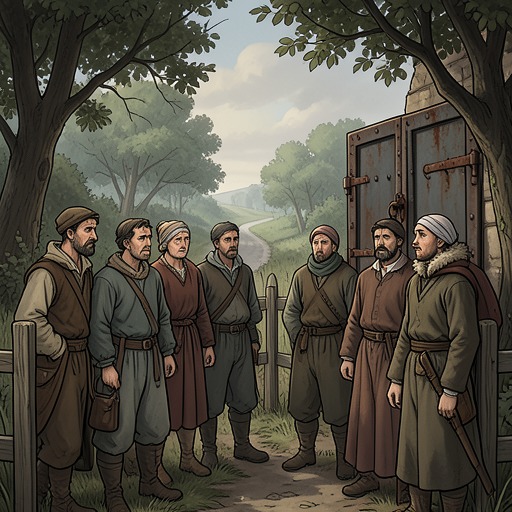
Division in Lipce over the squire’s proposed settlement
The PeasantsDivision in Lipce over the squire’s proposed settlement reveals how a promise of land can split a village whose people have previously acted together against the manor. The proposed exchange offers farmers access to fields and building timber, but its terms are not yet secured in writing, and the benefits appear unevenly distributed. Debate at the inn turns a shared grievance into competing calculations of trust, advantage, and fairness: some villagers lean toward accepting the offer, while Płoszka warns that the squire’s generosity may conceal another injury and a hired hand demands that laborers, too, be included.
The offer at Podlesie
At a crowded gathering in the inn, Grzela, the Voyt’s brother, explains the squire’s proposal by marking its terms in chalk on a table. The squire has promised each peasant four fields at Podlesie in exchange for a morgen of woodland, with an equivalent amount of land to be released in instalments. He has also offered wood on credit for cottages. Grzela sets out how the land would be divided and what each person might receive, presenting the arrangement as a tangible route to new holdings and building materials rather than as a vague assurance.
The offer carries particular force because it concerns resources the villagers already understand as tied to livelihood and customary claims. Earlier disputes over pasture and forest had involved villagers insisting that rights were recorded and that the manor was taking what belonged to them. Boryna had counted his four morgen in the forest, along with Jagna’s one, as part of what Lipce must defend. In the face of logging, he had led a crowd to confront the woodcutters, with villagers declaring the forest theirs. Against that history, the settlement is not simply a bargain: it proposes to resolve a collective dispute through specified exchanges and individual allotments.
Suspicion and competing calculations
Płoszka refuses to be persuaded by the apparent precision of Grzela’s chalk marks. When asked for his judgment, he argues that the villagers should not trust the squire until the promises have been put in writing. His suspicion rests on remembered grievances: in his view, the manor has repeatedly profited from the villagers’ wrongs, and the new offer may continue that pattern rather than repair it. His position cuts against the growing enthusiasm in the room, but it gives voice to a practical distinction between a proposal and a binding settlement.
The debate grows heated as Kłąb challenges Płoszka not to obstruct those who might accept the offer. Jankiel brings vodka to the table and calls for accord, and drinking accompanies a renewed round of argument. Most of the company increasingly favors agreement. The blacksmith speaks especially loudly in praise of the squire’s honesty and repeatedly buys drinks for the gathering, conduct the narration associates with his own financial interest in the matter. The combination of public persuasion, hospitality, and private advantage makes the meeting’s apparent consensus uncertain: assent may reflect hope of gaining land, but it is also formed under pressure from influential advocates.
The hired hands challenge the terms
The sharpest objection comes from Kobus, who has been present without speaking. As the farmers celebrate the proposed arrangement, he asks what will become of the hired hands and argues that they, too, are owed land. His protest exposes the division between those who can bargain for fields and those whose immediate need is employment and food. The settlement is discussed as a distribution among peasants, while the laborers who work in the village risk being treated as instruments of other people’s gains.
That exclusion matters in the wider conditions of Lipce. Hired workers are described as desperate for work during a severe winter; some have already lost potatoes to frost, have no incoming wages, and face the prospect of going to bed hungry before the next harvest. Elsewhere, accounts of poverty describe families with no potatoes left, a quilt sold, and little prospect of credit until harvest. The proposed allocation therefore meets a real need for land and security, but it does not answer the more immediate question of how landless workers will survive. Kobus presses the moral claim that a settlement cannot be called fair if some villagers acquire holdings while others remain exposed to hunger.
His intervention turns debate into open conflict. The company throws him out of the inn, but he continues cursing and threatening outside. His removal does not resolve the issue; it makes visible the cost of defining village agreement around the interests of those already positioned to receive land. The gathering’s celebrations and the worker’s expulsion occur side by side, exposing the gap between collective language and the boundaries of the proposed benefit.
A fragile village agreement
The dispute contrasts with the earlier forest mobilization, when farmers, hired hands, women, and older children assembled together to resist the felling. Then, the crowd’s claim centered on shared injury and a common demand that the manor stop cutting the forest. In the settlement debate, however, the prospect of specific allotments distinguishes potential beneficiaries from excluded workers, while uncertainty about the squire’s promises divides even the farmers. The community’s capacity for collective action remains real, but it does not erase differences of status or interest.
The episode presents the agreement as contested rather than completed. Grzela’s calculation makes its promised distribution legible; Płoszka’s insistence on written terms questions whether it can be trusted; the blacksmith’s advocacy complicates the appearance of disinterested support; and Kobus’s protest challenges the narrow definition of who deserves a share. The proposed settlement thus places the village between two forms of solidarity: resistance to the manor as a collective power, and responsibility toward poorer neighbors within Lipce itself. The division is not merely over whether to accept the squire’s offer, but over whose security the village is prepared to recognize.